
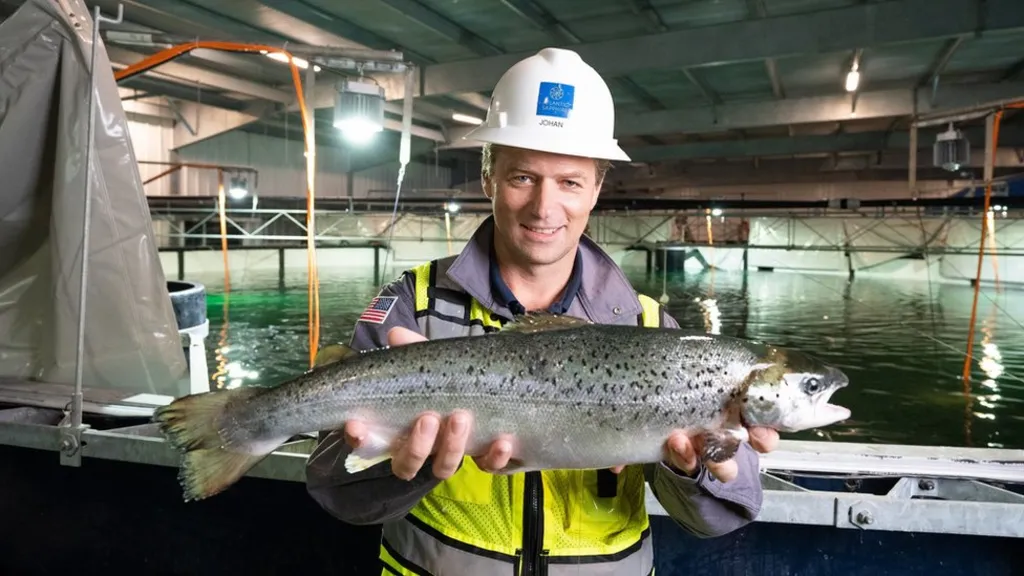
Salmon is the most technologically advanced farmed finfish, and the species most precision-aquaculture tools were first built around. It’s also farmed two very different ways, in marine sea pens and in a growing number of land-based recirculating systems, and good monitoring has to work in both.
The long grow-out raises the stakes
Atlantic salmon spend a long time in the water before harvest, and over a long cycle small errors compound. A biomass estimate that’s slightly off doesn’t just cost one week’s feed, it drifts feeding and harvest planning across months. That’s why continuous, whole-population sizing matters more for salmon than for a fast, short-cycle species: the longer the run, the more a reliable growth curve is worth.
In the pen: health and sea lice
Marine pens put salmon in open water, where sea lice, algal blooms, and passing disease are constant risks. The fish are spread through a large volume, and the site may be well offshore. Vision-based monitoring here focuses on catching behavioural change early, because in open water the difference between a problem found on day one and day ten is enormous. Edge processing at the pen keeps the models running on the thin connectivity offshore sites live with, sending back results rather than raw video.
On land: RAS and tight margins
Land-based salmon RAS is one of the fastest-moving areas in the industry, and it runs on tight margins where labour and feed dominate cost. In a closed system, accurate biomass feeds directly into feed precision, and continuous water-quality and behaviour monitoring catches the drift that escalates fast when there’s nowhere for a problem to dilute. The same monitoring approach carries across both environments, tuned to the conditions of each.
One approach, both systems
Whether salmon are in a pen or a tank, the core need is the same: non-invasive biomass, counting, and health monitoring that works without netting the stock. Delivering that as an upload-based survey, scheduled capture, or continuous in-pen monitoring lets an operation match the level of instrumentation to each site.
Our salmon page covers the species in more detail, our AI in sea pens page focuses on the marine side, and a free video analysis shows what the models read from your own footage.
- salmon
- sea pens
- RAS
See it on your own fish
Send us footage and get a free AI video analysis in 96 hours. No hardware, no cost.