
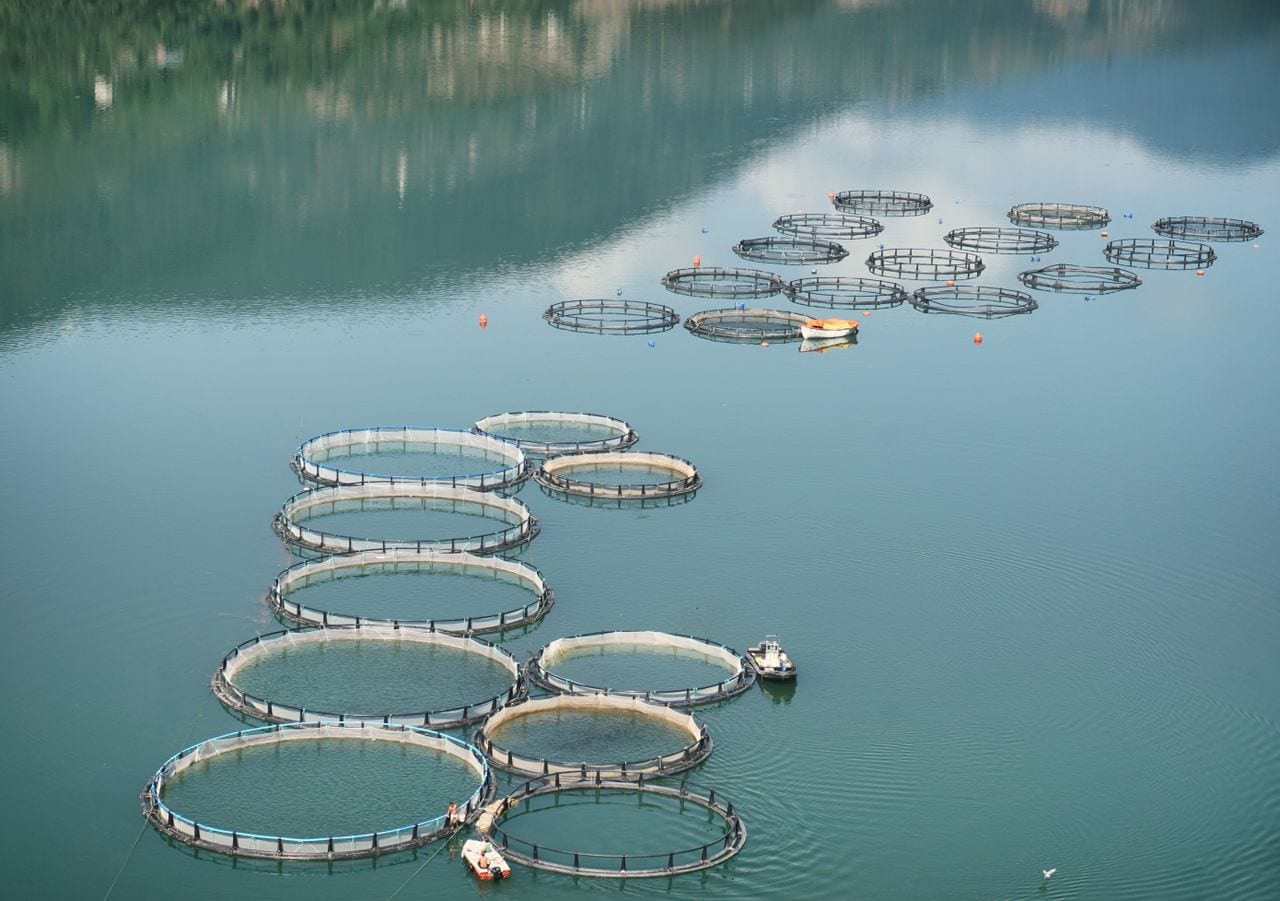
Sea pens hold most of the world’s farmed salmon and a growing share of other marine species, and they’re a harder place to see what’s happening than any tank. The stock is spread through a large volume of moving water, the site may be an hour offshore, and the connection back to land is often whatever a mobile signal can manage. Monitoring that works in a lab doesn’t automatically work here.
Why open water is the difficult case
In a pen, fish move through three dimensions and change depth with light, temperature, and feeding. A camera sees a slice of that volume, so the model has to build a reliable picture of the whole population from partial views over time. Water clarity shifts with weather and season, and biofouling slowly clouds every lens left in the sea.
None of this makes vision monitoring impossible, but it does mean the system has to be built for the conditions rather than ported from a clean tank. Models tuned on real pen footage, across clear and murky days, hold up where lab-trained ones fall over.
Health is the metric that matters most
In open water, the fish you can’t easily reach are the fish most exposed to sea lice, algal blooms, and passing disease. Early detection is worth more here than almost anywhere, because a problem caught on day one is a very different event from one caught on day ten.
Continuous behavioural monitoring is what makes early detection possible. Feeding response, swimming pattern, and crowding all shift before damage is visible, and a system watching every day picks up the change while there’s still time to respond.
Edge processing keeps it running offshore
The connectivity problem is real: you can’t stream days of high-resolution video back to shore over a thin mobile link. The answer is to process on site. An edge unit at the pen runs the models locally and sends back the results, biomass, counts, alerts, rather than the raw footage, then syncs fuller data when a connection is available.
That design is what lets monitoring keep working on the low bandwidth offshore sites actually have. Our AI in sea pens page covers the approach in more detail, and if you have pen footage already, a free analysis will show what the models read from your own water.
- sea pens
- offshore aquaculture
- AI monitoring
See it on your own fish
Send us footage and get a free AI video analysis in 96 hours. No hardware, no cost.