
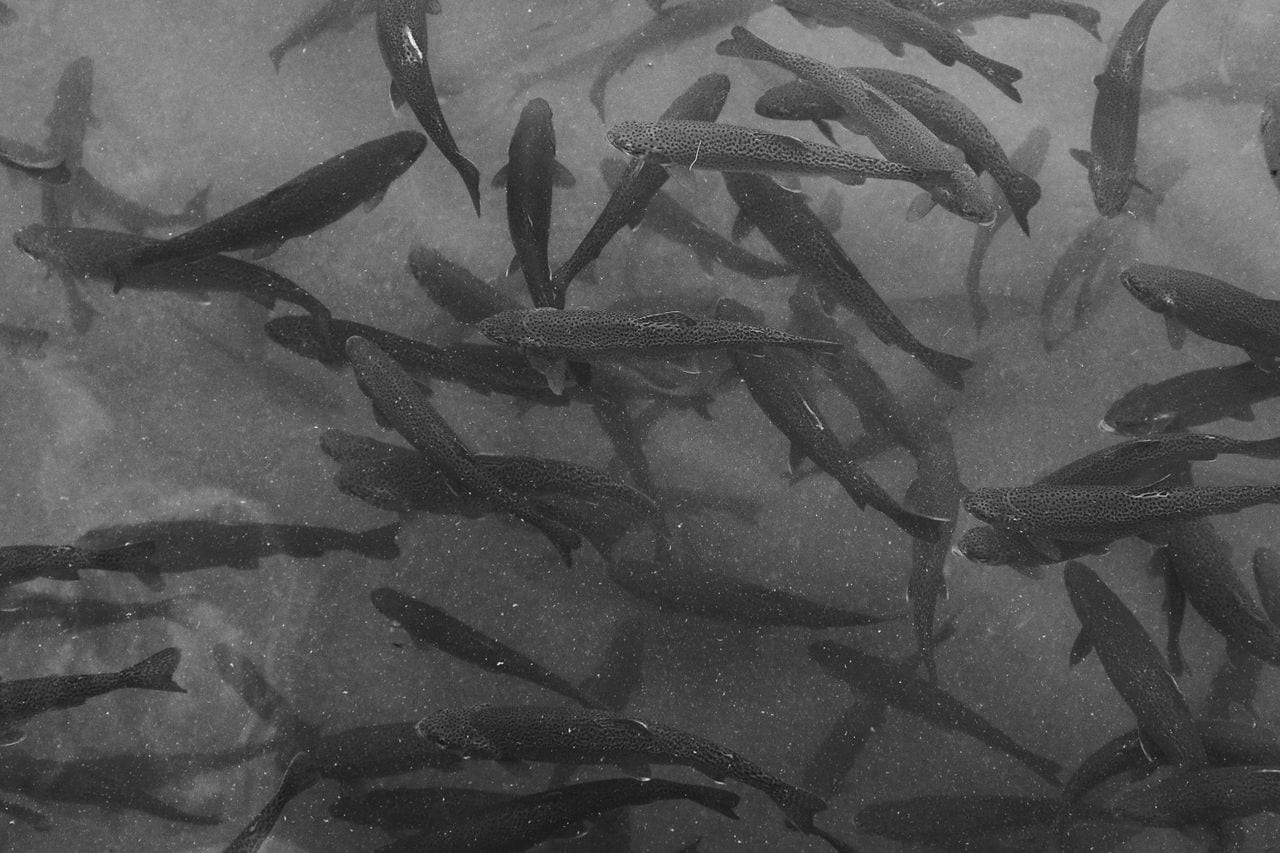
Counting fish sounds trivial until you have to do it with a tank of forty thousand. Every farmer has a story about a stocking number that turned out to be wrong, and how that one bad number quietly threw off feed rates, survival estimates, and harvest planning for the rest of the cycle.
Computer-vision counting exists to make that first number, and every number after it, something you can trust.
Where counting goes wrong
Manual counting happens at a few pinch points: when fingerlings arrive, at grading, and at harvest. Each one relies on either counting a sample and extrapolating, or counting by hand as fish move through a pipe or net. Both drift. Fish clump, they move fast, and a tired person counting the ten-thousandth animal is not as sharp as they were at the first.
The trouble is that the stocking count anchors everything downstream. If you think you have 5% more fish than you do, you overfeed by roughly 5% for months. Small errors compound.
How a vision counter works
A camera sits where fish pass in a predictable stream, at a transfer pipe, a grading channel, or a fixed point in a tank or pen. The model detects each fish as it enters the frame and tracks it across frames so the same animal is never counted twice. As fish cross a virtual line, the count ticks up.
Tracking is the hard part. In a dense flow, fish overlap and cross paths, so the model has to keep each identity straight for the fraction of a second it’s on screen. Modern detection-and-tracking models handle this well in clear water and hold up in the murkier, crowded conditions real farms deal with.
Counting and biomass, together
Because the same footage that counts a fish also measures its size, counting and biomass come from one pass. As the count climbs, the system also builds a size distribution, so a stocking event gives you both how many fish arrived and how big they are. That pairing is what turns a raw count into a decision: density, feed rate, and expected harvest weight all fall out of it.
What changes on the farm
Accurate counts sharpen every estimate that depends on them. Stocking density becomes real rather than assumed. Survival is measured against a true starting number instead of a hopeful one. And at harvest, you know what’s leaving the water before the truck arrives.
For farms without cameras yet, the easiest way in is footage you already have. Our fish counting page explains what the system reads, and you can upload a clip for a free count to see how it compares with your own numbers.
- fish counting
- computer vision
- aquaculture
See it on your own fish
Send us footage and get a free AI video analysis in 96 hours. No hardware, no cost.